Baptism in the Ancient Church In the first years of Christianity and at the time of the persecutions, no-one could be baptized unless they had first gone through the stage of catechism. When someone the bishop didn’t know wished to become a Christian, the responsibility for the sincerity of their motives was assumed by someone who was already a Christian, whom we know today as godparent. This person was a guarantor of the candidate in the eyes of the Church. Thereafter, candidates were enrolled in the registers of the Catechumens in the local Church and began their ‘apprenticeship’. They learned all the teaching of the Gospel of Christ concerning salvation and were initiated into the Church’s way of life. In the Church ...

The fourth evil-doer was Pilate, Caesar’s representative in Jerusalem, who in a sense stood for the whole of the pagan world at the trial of Christ. Pilate looked down on the Jews, and the Jews returned the favour. At first he wasn’t of a mind to become involved in Christ’s condemnation: ‘You take him and judge him in accordance with your law’ (John 18, 31), he said to those who brought the charges. Later he adopted a position in Christ’s favour and after a trial of sorts said to the Jews: ‘I find no fault in him’. (ibid, 38). In the end, in the face of threats such as ‘if you free him you’re no friend of Caesar’s’, Pilate agreed ...
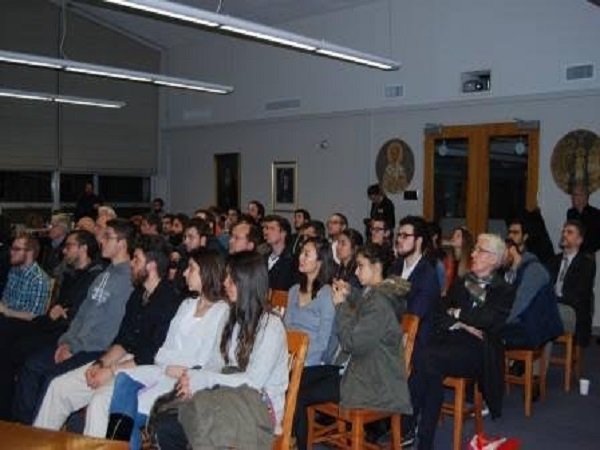
I say this because, in poetic thought we find revealed the kernel of a culture of incarnation, of a Church of incarnation, of a spiritual theater of incarnation, where the Other is not like our self, is not as we are, but actually is our self. This is stated in a different, but equally exceptional manner in the Doxastikon of Mattins on Great Saturday, which is what I would call a manifesto of Orthodox theology which, with the powerful lightning of the last days, transforms the important but imperfect «Give to the stranger» into the absolutely radical and extremely ontological «Give me this stranger». I therefore considered that tonight, in a place such as America, a place of such powerful migration, in ...

The Mother of hell is vainglory, which makes a fierce flame and feeds the poisonous snake. Whereas everything else ends with death, it continues to squabble even after death, to show off its nature over the dead body.

I mentioned the overwhelming feeling of liberation that we experience on Easter night, and I want to draw your attention to two texts which are good examples of this. The first is the Sermon of St John Chrysostom, which is read towards the end of the midnight vigil: Have any wearied themselves with fasting, let them now enjoy their payment. Has anyone laboured since the first hour, let them today receive their due. Did any come after the third hour, let them feast with gratitude. Did any arrive after the sixth hour, let them not hesitate: for there is no penalty. Did any delay until after the ninth hour, let them approach without hesitating. Did any arrive only for the eleventh ...

People should train themselves to recognize immediately, through the feeling in their heart, whether good or evil is coming towards them, in the same way as we identify savory and unsalted things, or sweet and bitter with the tongue. "Saint Nicholas Velimirovich" Read more “Words of Life” at www.pemptousia.com

Virtue is a really good, really beautiful thing. Virtuous people are at peace with themselves, pleasing to God and accepted by others. Even without wishing to, virtuous people attract the attention of others. Why is this so? Because they're like a pure fragrance which people want to smell.

The service of Great Saturday is effectively a funeral service for Christ, and yet it is the most colourful service of Holy Week, because we have already begun to celebrate the Resurrection. The Epitaphios which represents the tomb of Christ, is adorned with an array of flowers, and is carried in a solemn and yet joyous procession outside the church. There is on Great Saturday a clear, steady progression from sorrow to joy. The Engomia or Lamentations – those beautiful dirges that we sing on the evening of Great Friday in honour of Christ’s death – begin in the sombre plagal first, then becoming brighter and ending in the joyful and festive third tone. This progression continues and accelerates into ...

If each of us did whatever good we could, there wouldn’t be unhappy people in the world. "Patriarch of Constantinople Gregory V" Read more “Words of Life” at www.pemptousia.com

There's no worse torture than thought itself. There's no hell greater than thought that's completely cut off from the Creator and God of all thought, our Lord Jesus Christ, the Divine Word. Human thought without the Lord Jesus can know neither itself nor the world around it.

I am probably in serious trouble for saying that, so allow me to quickly move on before I really put my foot in it. Let us now turn our attention to the service of Great Friday that takes place on Thursday evening. At this service, we have the reading of the Twelve Gospels, which tell us the accounts of Christ’s trial, suffering and death. The fifth gospel sees Christ sentenced to death by crucifixion, and so, after this Gospel Reading, the priest takes the crucifix that stands before the altar, and, preceded by lights, he carries it around the church in procession and places it in the centre. Bear in mind what I said earlier: how the church expresses her ...

A large part of the responsibility for people's spiritual state lies with the family. If we want to rid children of various internal problems, then advice, coercion, reason and threats aren't going to be enough. They'll probably just make things worse. Correction comes through the sanctification of the parents.

Love of pleasure opens the door of our soul to the enemy. If you fight this with firm resolve, then it will be very difficult for any passion to overcome you. "Saint Theophan the Recluse" Read more “Words of Life” at www.pemptousia.com

O Lord Jesus Christ, Thou, Lamb of God, Who didst take upon Thyself the sin of the world, Who by Thine ascent to Golgotha didst redeem us from the curse of the Law and didst restore Thy fallen image; Who didst stretch Thy most pure hands on the Cross, gathering together in one the scattered children of God, and by the descent of the most Holy Spirit didst call all men to unity; Thou which art the brightness of the Father, before going forth to this great and sacred work for the salvation of the world, didst pray to Thy Father that all may be one, even as Thou art one with the Father and the Holy Ghost: do Thou ...

As we progress towards the Passion, events unfurl with dramatic speed, rich in significance and with a breathtaking plot as they proceed towards their culmination. We've already seen two actions which are related to the person of Christ and which are entirely opposite in nature. On the one hand, there was the sinful woman who came to Christ and paid Him humble honours; and, on the other, there’s one of His disciples, who reneges against Him and approaches the High Priests and Scribes in order to betray Him. The action of the woman indicates that His teaching had borne fruit, had convinced people about His love and kindliness. And the Lord indicated His pleasure at her act, accepted her gift and ...

As we come to the end of Great Wednesday, we move on from this theme of the Bridegroom, and on Great Thursday we commemorate the Mystical Supper and Jesus washing the feet of His disciples. In the morning, a full Eucharistic Liturgy of St Basil the Great is served in combination with vespers. The relationship between the Mystical Supper and the Eucharist is obvious, but many Orthodox talk about this Mystical Supper as though its sole purpose was to establish the sacrament of Holy Communion. This is just silly. I am not trying to play down the reality of Holy Communion as the Body and Blood of Christ or its connection to the Mystical Supper, but there is more to ...

On Great Tuesday, in the evening, the tropario of Kassiani is sung in Orthodox Churches. This is a poetic rendition of the event described in the Gospels where a sinful woman shows her repentance by laving Christ’s feet with precious ointment and wiping them with her hair. The woman’s action is significant for two main reasons: 1. It prepared Christ for burial, since the Jews used to anoint the bodies of their dead with a mixture of resin and spices. 2. The intensity of the scene demonstrates the magnitude of her repentance. The particularity of her action has led to associations unrelated to what actually happened, with the result that a number of myths have been woven around the identity of this woman and ...

Knowledge is awareness of God. If you really want to know God, get to know yourself first.

Having established the identity of Christ, let us now begin getting to grips with what He did for us, meaning above all, the events of Holy Week. The Monday, Tuesday and Wednesday of Great Week are marked by the service of the NYMPHIOS (the Bridegroom Service). The morning service of each day takes place on the evening of the night before in anticipation. Each day liturgically begins at sunset, and so the service of Monday is held on Sunday evening, the service of Tuesday on Monday evening, and so on. On Sunday evening, the priest, preceded by lights, and bearing the icon of the Bridegroom makes a solemn procession within the church and places it in the centre, while we sing ...

The woman who had fallen into many sins, perceiving Thy divinity, O Lord, fulfilled the part of a myrrh-bearer; and with lamentations she brought sweet-smelling oil of myrrh to Thee before Thy burial. ‘Woe is me’, she said, ‘for night surrounds me, dark and moonless, and stings my lustful passion with the love of sin. Accept the fountain of my tears, O Thou who drawest down from the clouds the waters of the sea, Incline to the groanings of my heart, O Thou who in Thine ineffable self-emptying hast bowed down the heavens. I shall kiss Thy most pure feet and wipe them with the hairs of my head, those feet whose sound Eve heard at dusk in Paradise, and ...